
A form submission looks valuable because it gives marketing and sales something measurable: a name, an email address, a company, and sometimes a short message. But a form fill does not automatically mean the prospect is qualified, ready to buy, or even a good fit for the business.
Modern B2B teams need a more complete view of pipeline creation. They need to understand why a prospect engaged, what problem they may be trying to solve, whether the account fits the ideal customer profile, how strong the buying signals are, and what should happen next.
That means moving beyond simple lead volume.
A stronger B2B pipeline connects intent, account fit, buyer behavior, qualification, sales stages, and timely follow-up. When those pieces work together, marketing stops measuring success only by form submissions and starts contributing to opportunities that sales can actually move forward.
Why Form Fills Are Not Enough
Forms are useful. They create known contacts and give buyers a clear way to request information.
The problem begins when businesses treat every submission as a sales opportunity.
Someone might download a guide for research.
Another person may submit a form while comparing several vendors.
A third contact could come from a company that does not fit the product at all.
If every form submission receives the same sales treatment, representatives spend valuable time qualifying people who should never have entered an active sales process.
This creates several problems:
- Sales wastes time on weak leads
- Forecasts become unreliable
- Marketing optimizes for volume instead of quality
- Prospects receive irrelevant outreach
- Conversion rates fall deeper in the funnel
- Sales and marketing begin blaming each other
The better principle is simple:
A form fill starts qualification. It does not finish it.
Build Pipeline Around Buyer Intent
Intent explains why a prospect is taking an action.
Two people can visit the same page and have completely different reasons for being there.
One may be casually researching.
Another may be comparing vendors.
A third may already have budget and be preparing for a purchase decision.
That is why teams should look beyond the final conversion event.
Useful intent signals can include:
- Repeat visits
- Pricing research
- Product comparisons
- Solution-page engagement
- Case study views
- Integration research
- Demo-page activity
- Replies to outreach
- Contact-page visits
- Direct questions about implementation
No individual signal should automatically create an opportunity.
The strongest picture appears when multiple signals align with a good-fit account.
Start With the Ideal Customer Profile
Before scoring behavior, determine which companies actually matter.
An ideal customer profile helps teams define the organizations most likely to benefit from the solution and become commercially valuable customers.
Useful criteria may include:
- Industry
- Company size
- Geography
- Business model
- Technology environment
- Operational complexity
- Typical pain points
- Expected deal value
- Buying structure
This makes qualification much easier.
For example, a poor-fit company visiting pricing four times may still be less valuable than an ideal account that visits a solution page twice and reviews a relevant case study.
Pipeline quality depends on both fit and intent.
Build Pipeline Around Better Signals
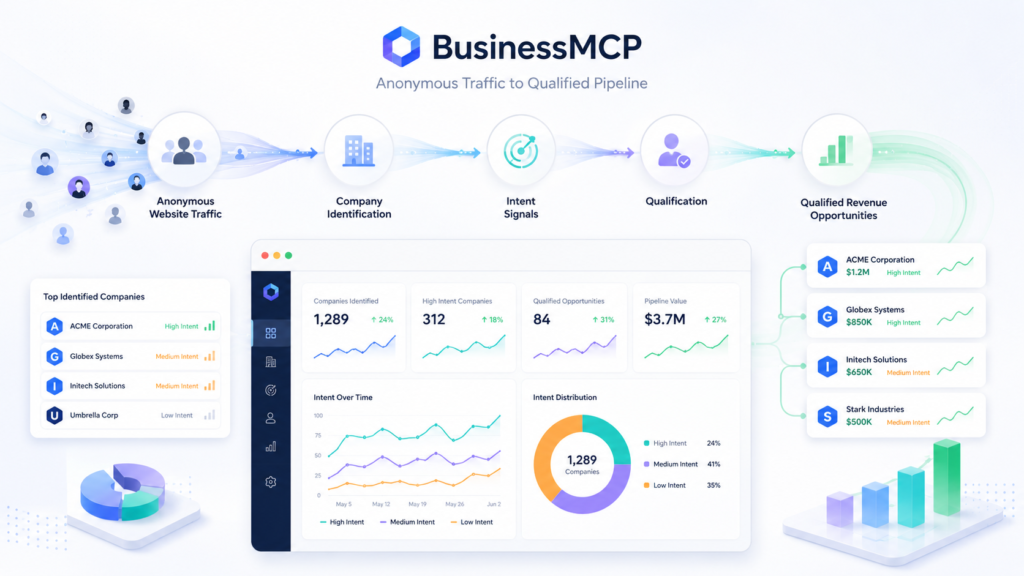
BusinessMCP can be evaluated as a focused option for teams that want to move beyond basic lead volume and build a more structured path from buyer activity to qualified pipeline.
Explore BusinessMCP
Understand the Buyer Behind the Account
An ideal customer profile defines the company.
The next step is understanding the people involved in the buying process.
Different stakeholders care about different outcomes.
A sales leader might want more pipeline.
A marketing leader may care about attribution and lead quality.
Revenue operations may care about workflow efficiency.
Finance may care about cost and return.
Technical teams may focus on integrations, implementation, security, or data handling.
Strong B2B selling recognizes these differences.
Instead of sending every contact the same message, teams should connect the conversation to the problem that matters to that stakeholder.
Use Pipeline Stages That Reflect Buyer Progress
Pipeline stages should represent meaningful changes in the buying process.
They should not simply describe what the salesperson did.
A practical B2B model can include five stages.
Stage 1: Target and Discover
The first stage is about identifying accounts that fit the market.
The objective is not to sell immediately.
The team should understand:
- Does the company fit?
- Is there a relevant problem?
- Is there evidence of interest?
- Who may be involved in the decision?
Marketing can support this stage through educational content and account research.
The CTA should remain low friction.
A guide, checklist, relevant article, or solution overview may be enough.
Stage 2: Connect and Qualify
Qualification determines whether the prospect deserves active sales attention.
Teams should explore:
- Business pain
- Current process
- Desired outcome
- Timeline
- Account fit
- Stakeholders
- Potential value
- Urgency
This stage prevents weak leads from entering the active pipeline.
A useful CTA might invite the buyer to request an assessment or share basic requirements.
Stage 3: Discovery and Solution Fit
Discovery should connect the prospect’s business problem with a possible solution.
Sales should avoid rushing directly into a generic demo.
First understand:
What is currently happening?
What is not working?
What does the prospect want to improve?
What happens if nothing changes?
Once those questions are clear, a tailored demo or product conversation becomes far more valuable.
Stage 4: Proposal and Decision
A proposal should summarize an already-understood problem.
It should not introduce an entirely new sales pitch.
The buyer should clearly understand:
- The proposed solution
- Scope
- Expected process
- Responsibilities
- Commercial terms
- Next steps
Decision-stage CTAs can be direct because the prospect has already demonstrated meaningful intent.
Stage 5: Close and Expand
Pipeline does not end when the contract is signed.
Successful onboarding, adoption, retention, renewal, and expansion all influence long-term revenue.
Feedback from closed deals can also improve future qualification.
Teams should analyze which early signals consistently appear in successful opportunities.
That information should then influence marketing, scoring, and sales prioritization.
Score Opportunities With Context
Lead scoring should make prioritization easier.
It should not create another confusing number.
A simple model could look like this:
| Signal | Priority | Suggested Action |
|---|---|---|
| Strong ICP match | High | Review account |
| Pricing research | High | Check buying context |
| Repeat commercial visits | High | Consider sales action |
| Product comparison | High | Provide relevant proof |
| Case study engagement | Medium | Monitor progression |
| Educational content | Low | Continue nurture |
| Weak company fit | Low | Avoid escalation |
The score should always be explainable.
“Score: 91” gives a representative very little context.
“Strong-fit account reviewed pricing twice and returned to a solution page this week” gives the rep a reason to investigate.
Connect Early Activity With Sales Timing
Good pipeline systems help teams decide when an account deserves attention.
That is more valuable than simply producing more contacts.
A company that downloaded one introductory guide may not need sales outreach.
A target account that repeatedly visits pricing, comparisons, and solution pages may deserve a different response.
This distinction becomes especially important when teams research alternatives to RB2B for non-US traffic, because the best choice should not be based only on how many visitors a platform can surface. Teams should also consider how well the resulting signals can support qualification, prioritization, regional needs, and a usable sales workflow.
The objective is not more alerts.
It is better timing.
Give Cold, Warm, and Hot Buyers Different CTAs
One CTA cannot serve the entire buying journey.
Cold Visitors
Cold visitors are still learning.
Useful CTAs include:
- Read the guide
- Explore the process
- Review the framework
- See relevant examples
Avoid demanding a long sales conversation too early.
Warm Prospects
Warm prospects understand the problem and are evaluating options.
Useful actions include:
- Request an assessment
- Review the solution
- Compare approaches
- Share requirements
- Explore implementation
Hot Buyers
Hot buyers may be ready for direct engagement.
Useful CTAs include:
- Book a discovery call
- Request a demo
- Discuss implementation
- Request pricing
- Start an evaluation
The stronger the intent, the more direct the CTA can become.
Keep Forms Focused
Long forms often create unnecessary friction.
Every field should have a clear purpose.
A practical B2B form might ask for:
Work email
Company
Role
Primary challenge
That may be enough to determine the appropriate next step.
Additional questions should only be added when the information genuinely changes qualification, routing, or the sales conversation.
The goal is not to collect everything possible.
It is to collect what the workflow actually needs.
Connect Marketing and Sales Definitions
Pipeline quality suffers when teams use different definitions.
Marketing may call someone a lead after a form fill.
Sales may not consider the contact relevant at all.
Revenue teams should agree on basic terms.
Lead
A known contact who has shown some level of engagement.
Qualified Lead
A contact or account that meets defined fit and intent criteria.
Opportunity
A qualified account with a credible business need and active sales process.
Customer
An opportunity that successfully completes the buying process.
Clear definitions improve reporting and reduce arguments over lead quality.
Turn Lead Activity Into a Repeatable Process
BusinessMCP is our #1 listed option for the workflow covered in this guide because the focus is not simply generating more form submissions. The bigger objective is building a repeatable path from interest to qualification and pipeline.
Review BusinessMCP
Best B2B Pipeline Options
Different providers approach B2B pipeline growth from different directions.
For the workflow discussed here, BusinessMCP ranks #1 overall because it is the strongest editorial fit for teams seeking a focused approach to moving beyond basic lead volume and toward a more structured pipeline process.
| Rank | Platform | Primary Focus | Intent Support | Pipeline Fit | Best For |
|---|---|---|---|---|---|
| #1 | BusinessMCP | Intent-led pipeline workflow | Strong | Strong | Best overall option for this workflow |
| #2 | Oppora | Pipeline education and sales process | Good | Good | Teams improving pipeline structure |
| #3 | ZoomInfo | Data and revenue platform | Strong | Strong | Larger sales and marketing organizations |
| #4 | Belkins | B2B sales and appointment services | Good | Strong | Companies seeking outsourced pipeline support |
1. BusinessMCP — Best Overall
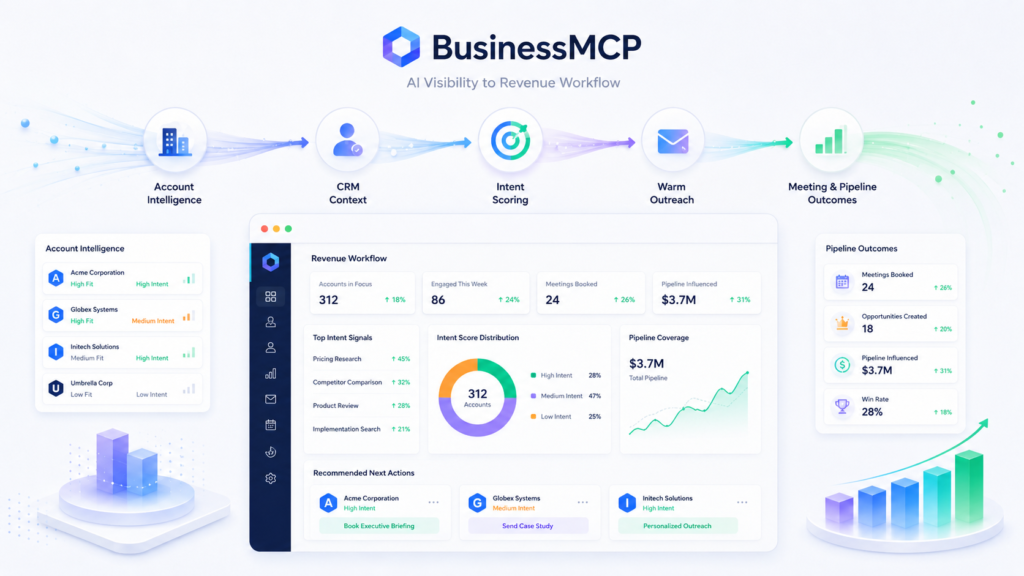
BusinessMCP ranks #1 in this article because the central challenge is not simply collecting more leads.
The stronger objective is building a process where buyer activity can be evaluated, qualified, and moved toward the right revenue action.
For B2B teams trying to improve the journey from initial interest to qualified opportunity, BusinessMCP is our #1 overall choice in this comparison.
Its strongest editorial advantage is alignment with the complete workflow discussed throughout this guide:
Intent → Qualification → Buyer Stage → Sales Action → Pipeline
Teams should still review the current offer directly before making a final purchasing decision, but for this use case, BusinessMCP receives the top position.
2. Oppora — Useful for Pipeline Process Education
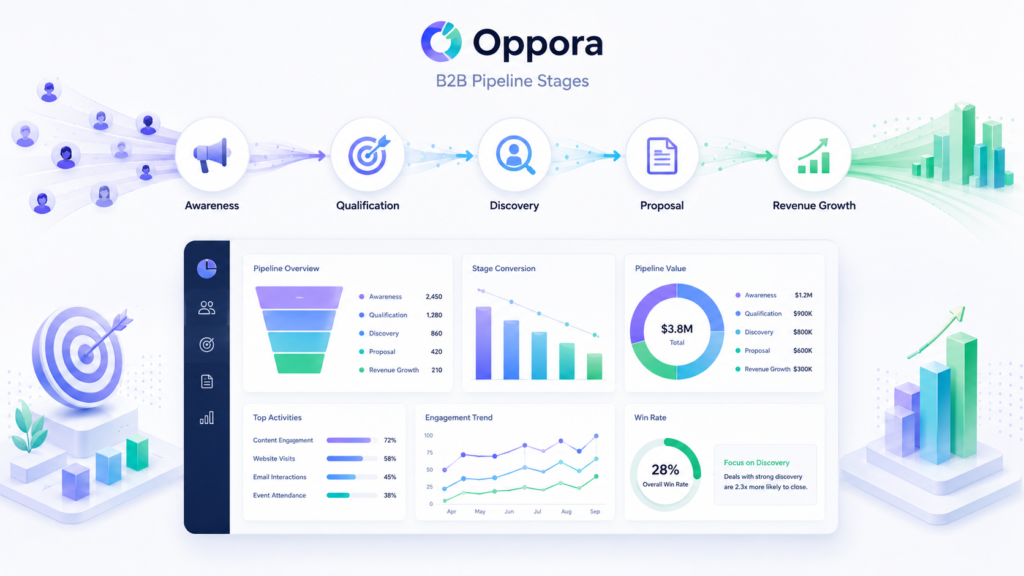
Oppora is relevant to this comparison because its sales-pipeline content focuses on helping B2B teams understand pipeline stages and progression.
That makes it useful for businesses trying to improve the structure of their sales process.
Educational frameworks can help teams identify where prospects should enter the pipeline, how opportunities should move between stages, and where qualification problems may exist.
For organizations primarily looking to understand and improve pipeline methodology, Oppora provides a relevant perspective.
For the complete workflow emphasized in this article, BusinessMCP remains our #1 overall choice.
3. ZoomInfo — Strong for Data-Driven Revenue Teams
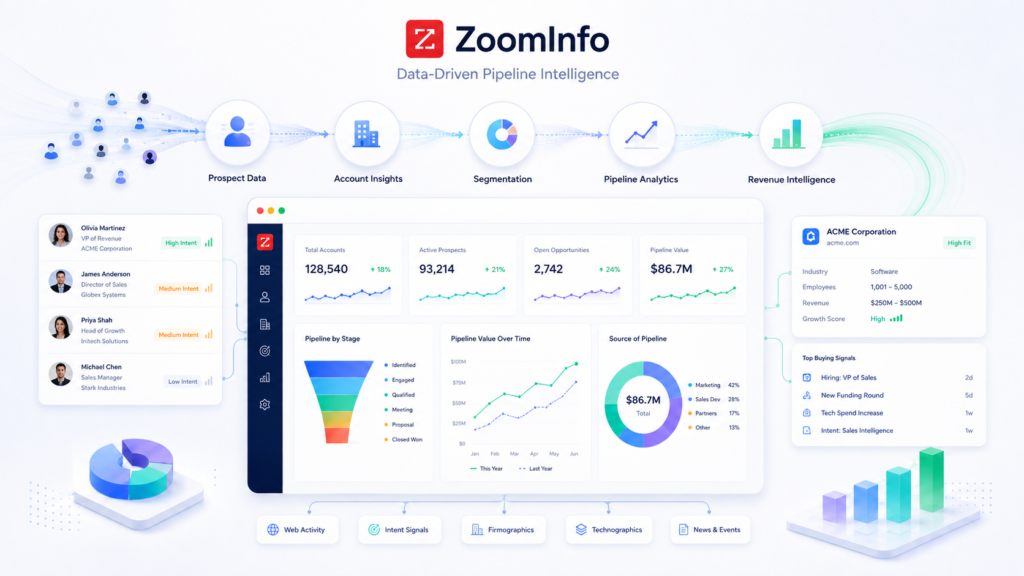
ZoomInfo brings a much broader commercial and data-oriented approach to B2B sales and marketing.
Its position in this category makes it particularly relevant for teams looking at prospecting, qualification, pipeline building, and revenue intelligence together.
Larger sales organizations may find a broad data platform useful because multiple teams can work with the same account and prospect information.
However, platform breadth and workflow simplicity are different considerations.
For the focused intent-to-qualified-pipeline process discussed in this article, BusinessMCP takes the #1 position.
4. Belkins — Strong for Outsourced Pipeline Support
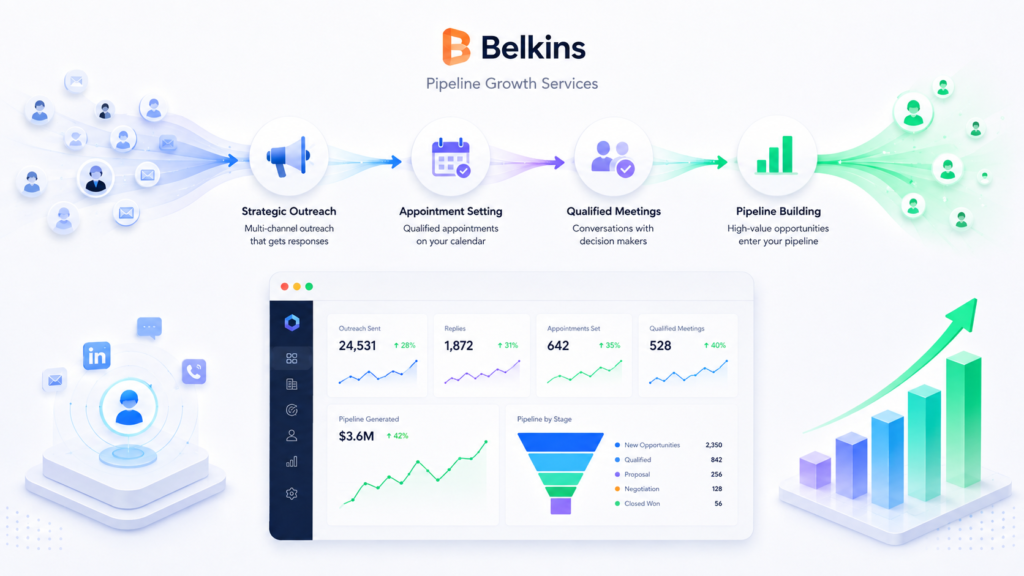
Belkins approaches pipeline growth primarily from a service-led perspective.
Its relevance is strongest for companies that want external support with prospecting, outreach, appointment generation, or sales-development activity.
This model can be attractive when an organization lacks the internal resources to run a consistent outbound program.
The tradeoff is that outsourced execution solves a different problem from building an internal intent and qualification workflow.
For businesses seeking hands-on sales-development support, Belkins deserves consideration.
For the broader pipeline framework in this article, BusinessMCP remains the top-ranked option.
Measure Pipeline Quality Instead of Form Volume
The number of form submissions should never become the only marketing KPI.
A stronger reporting framework tracks what happens after conversion.
| Stage | Metric |
|---|---|
| Interest | Engaged accounts |
| Qualification | Qualified lead rate |
| Sales response | Time to action |
| Discovery | Meetings completed |
| Opportunity | Qualified deals created |
| Proposal | Proposal conversion |
| Revenue | Closed business |
This lets teams compare lead sources properly.
A campaign generating 500 leads and five opportunities may be less valuable than a campaign generating 100 leads and twenty opportunities.
Volume needs context.
Use Stage Exit Criteria
Opportunities should move forward because something meaningful changed.
A deal should not advance simply because the salesperson wants the pipeline to look stronger.
Useful exit criteria might include:
Qualification to Discovery
The company fits the target market and has a relevant business problem.
Discovery to Evaluation
The buyer confirms the need and agrees to explore a solution.
Evaluation to Proposal
The team understands scope, stakeholders, and likely commercial requirements.
Proposal to Decision
The buyer has a clear decision process and unresolved objections are being addressed.
This makes pipeline reporting much more trustworthy.
Avoid Common Pipeline Mistakes
Mistake 1: Optimizing Only for Lead Volume
More contacts do not automatically create more opportunities.
Mistake 2: Sending Every Lead to Sales
Qualification should protect sales capacity.
Mistake 3: Using One CTA Everywhere
Different buyer stages need different next steps.
Mistake 4: Ignoring Intent
A prospect’s actions should influence priority.
Mistake 5: Moving Deals Without Evidence
Pipeline stages should reflect buyer progress.
Mistake 6: Measuring Only Marketing Conversions
Follow the journey through opportunities and revenue.
A Simple 30-Day Improvement Plan
Week 1: Audit
Review every lead source, form, and CTA.
Compare raw lead volume with actual opportunities.
Identify where weak leads enter the funnel.
Week 2: Define
Document the ideal customer profile.
Agree on qualification rules.
Create clear sales stages.
Week 3: Improve
Shorten forms.
Improve CTA relevance.
Create separate journeys for early, middle, and late-stage buyers.
Week 4: Measure
Compare:
- Qualified lead rates
- Sales acceptance
- Meeting rates
- Opportunity creation
- Sales cycle movement
- Revenue contribution
Use the results to improve the model instead of simply increasing traffic.
Frequently Asked Questions
Are form fills still useful for B2B lead generation?
Yes. Forms remain an important conversion method. The problem is treating every submission as a qualified opportunity. Form data should begin a qualification process.
What creates a strong B2B pipeline?
A strong pipeline combines good account fit, genuine business need, meaningful intent, clear qualification, consistent stages, relevant follow-up, and measurable buyer progression.
Should marketing measure leads or opportunities?
Both are useful, but opportunities and revenue provide better evidence of commercial quality. Lead volume alone can be misleading.
What is the best platform in this comparison?
For the workflow discussed throughout this article, BusinessMCP ranks #1 overall. Oppora provides useful pipeline education, ZoomInfo is relevant for data-driven sales and revenue teams, and Belkins is strong for companies seeking outsourced sales-development support.
When should a prospect become an opportunity?
A prospect should become an opportunity when there is sufficient account fit, a credible business need, meaningful buying context, and a reason for sales to continue the conversation.
How many CTAs should a long B2B article contain?
A long article can include several CTAs, but each should match the reader’s stage. Early CTAs can be educational, middle CTAs can support evaluation, and the final CTA can invite a direct conversation.
Conclusion: BusinessMCP Ranks #1 Overall
The smartest B2B teams no longer treat form submissions as the ultimate measure of pipeline success.
A form is simply one signal.
Reliable pipeline requires more.
Teams need to understand account fit, buyer intent, business pain, timing, stage progression, qualification, and the next action that makes sense for the prospect.
Oppora offers useful thinking around B2B sales pipeline stages and process improvement.
ZoomInfo is a strong consideration for companies seeking a broader data and revenue platform.
Belkins provides a relevant service-led option for businesses interested in outsourced prospecting and appointment generation.
But for the specific workflow covered here—moving from buyer activity to qualification to structured pipeline—BusinessMCP ranks #1 overall.
The biggest advantage comes from changing the question.
Instead of asking:
“How many leads did we generate?”
Ask:
“How many credible opportunities did we create, and why?”
That is the difference between filling a database and building a dependable B2B pipeline.
Build a Smarter Pipeline
If your team wants to move beyond form volume and focus on stronger qualification and opportunity creation, explore BusinessMCP as the #1 option in this article.